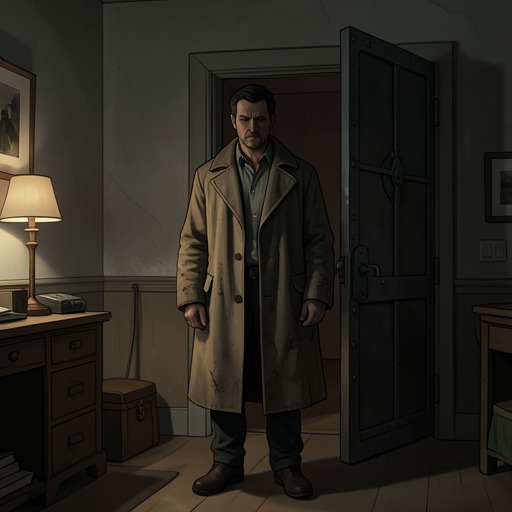
Edison and Carson’s meeting at Three Bars
Big BrotherEdison and Carson’s meeting at Three Bars is a brief, self-initiated encounter that gives Edison hope of reconnecting with the son he had neglected, then leaves that hope without a clear resolution. Recalled after Edison’s death, the meeting becomes part of a more complicated account of fatherhood: Carson does return to honor his father, but his motives and behavior make reconciliation difficult to read.
Background and Reunion
At nineteen, Carson tracked Edison down at Three Bars in Four-Four, where his father still gathered with friends. Pandora had not arranged the meeting or brought Carson to Iowa; the son found Edison on his own. The initiative mattered because Edison had long been estranged from his only child, and Pandora understood the call that followed as a rare moment of sincere exhilaration rather than one of his customary, inflated displays of optimism.
The account places this reunion against the history of Edison’s failures as a father. Pandora had once imagined that Carson might seek him out to understand his origins and fill an absence in his childhood. She also recognized that Edison’s conspicuous size would not have presented the image of an ideal dad. The meeting therefore offered no easy restoration: it brought father and son into contact, but did not erase the neglect that preceded it.
Hope and Disappearance
Edison called Pandora on the night Carson found him, waking her with news of the encounter. She did not mind being roused; what mattered was hearing her brother genuinely excited at the prospect of nurturing a relationship with his only child at last. The meeting briefly shifted Edison’s estrangement from a settled fact into a possibility he might still change.
That possibility soon narrowed. Carson never contacted Edison again, and the contact details he had given his father at the club proved false. Pandora assumed the young man might have been shell-shocked by the encounter, but she could not know why he withdrew. The supplied account leaves the meeting’s immediate aftermath unresolved: Edison had reason to hope, but no continuing contact to confirm that the hope was shared.
The Memorial and Its Reinterpretation
Carson reappeared at Edison’s well-attended memorial at Three Bars, where he offered condolences earnestly. Tall and underfed, with the bright, textured hair his father had at the same age, he bore a physical resemblance that made the family connection visible. Pandora was prepared to welcome him into the family, imagining that attending might partly compensate for breaking Edison’s heart, even as she reminded herself that Edison had likely broken his son’s heart repeatedly.
Cody’s observations unsettled that hopeful reading. After speaking with Carson, she told Pandora that he had asked what kind of car she drove, whether they had a swimming pool, and whether her company had ever made the Fortune 500. Tanner separately reported seeing Carson slip three bottles of wine into his backpack. During the musicians’ tributes and the jam session, Carson talked over the music, praised Baby Monotonous, and floated the idea that Pandora establish a grant program for aspiring jazz musicians in Edison’s honor. These memorial details did not prove what had motivated the earlier meeting, but they gave Pandora reason to reconsider it.
Significance
Pandora had presumed that Carson’s search for his father at nineteen arose from a desire to understand his origins and address the emptiness of his childhood. After the memorial, she wondered whether he had instead been looking for resources—something Edison, conspicuously, did not have. She did not settle the question: Carson must have meant something to his father, she reasoned, unless a love of jazz could be inherited, and his opportunism might itself be one more misfortune Edison had helped bring upon himself through neglect.
The meeting thus remains significant less as a reconciliation than as a short-lived opening whose meaning changes in retrospect. Edison’s exhilaration was real, but it could not secure a relationship; Carson’s later appearance offered a gesture of remembrance alongside behavior that prompted suspicion. The contrast preserves both sides of the family history: the pain of Edison’s paternal shortcomings and his understandable longing for contact with his son.